Sunday, December 24, 2006

Places To Do Community Service Hours

patents on RSS

we are trying very quietly. Microsoft is indeed trying to patent RSS . Mica stuff just eh.

For further details, I refer you to a great post on Wired , which addresses the issue. If you wish to leave a comment on the case, well for what is the forum GT . ;)

While you are there, Merry Christmas to all readers of this blog.

Cheers.

Wednesday, December 20, 2006

Long Does Take Ice Freeze

Italians and Microsoft Internet Conference

Italy late in the EU for presence of the Internet in homes : in our country - the fifteenth in the standings - are linked to 40% of all households, while the European average is 52% . And 'one of the data in the 2006 Istat report on new technologies.

Internet in the EU. Leading the European Union are Holland (80%), Denmark (79%), Sweden (77%) in tail Greece (23%), Slovakia (27%), Hungary (32%). We are close to France (41%), Spain (39%), Portugal (35%).

The most common goods. In the technology sector, are television, present in 93.9% of households and mobile (82.3%). Below the video recorder (63%), the DVD player (50.7%), the personal computer (46.1%), Internet access (35.6%).

More and more cell phones. Compared to 2005, increased primarily possession of the phone (80, 8 to 82%, 3%) and personal computer (from 43.9% to 46.1%). Internet access is fairly stable (from 34.5% to 35.6%) but improves the quality of connection: reduce that narrowband (dial-up modem or traditional telephone line ISDN), which increased by 21.6% to 18.7%, and instead increase as broadband (ADSL or other), which increased from 11 , 6% to 14.4%.

The generation gap. Among the different types of family are strong technological gap. The nuclei consist of only the elderly continue to be excluded: only 5.5% own a personal computer, only 2.8% have access to the Internet and is almost entirely lacking the spread of broadband connections (1.1 %). The only common good (except the TV) and mobile phones (45.3%). At the other extreme, households with at least a minor possessing the personal computer e l'accesso ad Internet rispettivamente nel 69,7% e nel 51,8% dei casi.

Il divario economico-sociale. Nelle famiglie con capofamiglia dirigente, imprenditore o libero professionista il possesso del cellulare (96,3%) ha superato quello della televisione (94,5%). Molto diffusi anche personal computer (80,6%), accesso a Internet (70,2%) e i beni tecnologici legati al televisore come l'antenna parabolica (44,7%), il decoder digitale terrestre (26%), la tv digitale (12,9%) e il lettore dvd (78,1%). Tra le famiglie con capofamiglia operaio e quelle in cui il capofamiglia è dirigente, imprenditore o libero professionista c'è una differenza di circa 30 punti nel possesso di personal computer e di 37 punti nel possesso di accesso a internet.

Il divario territoriale. L'uso di pc e internet è più diffuso nel Nord-ovest (rispettivamente 46,4% e 39%). Diversa la situazione nel Sud e nelle Isole dove le percentuali di utilizzo sono più basse (intorno al 35% per il personal computer e al 27% per internet). Va sottolineato, inoltre, che dal 2003 al 2006 le differenze tra Nord e Sud del Paese sembrano leggermente aumentate: la distanza nell'uso del personal computer tra il Nord-ovest e il Sud era di circa 8 punti percentuali nel 2003 ed è diventata di 12 punti percentuali nel 2006.

Le età. Il picco di utilizzo del personal computer has between 11 and 19 years (over 75%) and the Internet between 15 and 24 years (more than 67%) and decreases with increasing age. Even among people of 35-44 years the use of personal computers (53.8%) and internet (45.7%) is much smaller. Among people aged 60-64 only 16.4% use their personal computer, and 12.3% use the Internet, over sixty of the use of these technologies is marginal.

activities. What do you do on the Internet is yanked age-related users. Between 20 and 44 years more than 80% of users use the Internet primarily to send or receive email. Using the web to chat, however, is particularly widespread among young people of 15-24 (over 43%), as well as using the web to play games, download games, pictures and music that is most widespread among people of 6-19 years (over 60% ). The training activities at schools and universities is very common among 18-24 year olds (over 41%), while the vocational training activities are mainly practiced by individuals aged 20 to 59 years (with higher values 15%). [Via republic ]

Sunday, November 19, 2006

Pittsburgh Restaurant

GT: Expert SEO and SEM to compare credit cards online

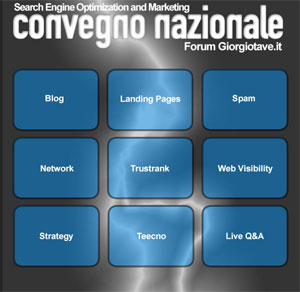
Convegno GT 2006 was time to talk about the conference GT also among the pages of my personal blog. For those who asked what the conference is concerned, here's the answer: the GT conference is an opportunity to meet and discuss on certain topics in the search marketing world. Where and when? The location chosen is Florence, at the Grand Hotel Adriatico, dates are 9 and 10 December pv

What you will discuss? The topics that will benefit from insights and case histories ranging from blogs, SEO, landing pages that convert through and still to interact with browsers which starts from the pages of search engines, Web 2.0, etc ...

Participation in the National Conference GT SEO / SEM bound to a request for pre-registration, you can make here, where you will also find information on the agenda of the conference.

The cost of participation in both days, finally, is 420 € + VAT.

Thursday, September 14, 2006

Whats That Song Dun Dun Dun Dun


In the popular imagination, the Internet is often perceived as a place highly insecure to use credit cards . A true belief in half, you can still prevent a careful and cautious attitude.

It is thought the Internet as the main place of computer frauds based on the use of illegal credit cards. This statement, however, contains elements of great imprecision. First of all, under the law, you can not talk to computer fraud for the illegal use of credit cards. It is a crime in itself. While computer fraud fall under Article 640ter of the Criminal Code, the scams they see the misuse of credit cards stolen from legitimate owners fall under Article 12 of the special law 197/91.

Often, of course, the two articles help to define the offense, but in any case it is more correct to speak of fraud. In addition, the Internet is the place where the more you use credit cards - also acquired illegally - to complete the purchases. It is not the place where most it is easy to perpetrate identity theft.

The subtraction of the data
Among the techniques of removal of sensitive credit card, only two can be traced specifically to the Internet, while others refer to a traditional offline operations. All techniques, however, usually designed to steal sensitive data needed to complete the transaction: the cardholder name, card number, expiration date and security code (the three digits on the back of card).

subtraction techniques in an Internet
The methods used to gain possession on the Internet credit card data are mainly two. There are traditional ways of hacking, in which the bad guys get in the way in communications systems and steal data, and there are the most innovative techniques of phishing, a real fishing of the fish bite the bait thrown into the sea on the Web In the first case, fraudsters take advantage of advanced computer skills to enter the online database of sites that hold sensitive data, or to intercept communications between customers and sellers (or banks) copying sensitive data.

In the second case, the criminals create pitfalls of virtual users to get directly to their sensitive data. In more advanced phishing (and widespread in the recent times), he lets you believe to be contacted by your bank to renew the information available to the institution itself. Then takes the user on a site - a photocopy of the original in order to deceive him and make him commit the faux pas to report their data.

The traditional techniques
However, the incidence increased in cases of theft of data is provided by traditional techniques, which take place in the real world. In particular, in the case studies are cited as the box and trashing the most popular methods. The first is to intercept the bank-customer communication through the mail, in order to steal all the information necessary. Similarly, the trashing means actions to recover data from old receipts or statements, often thrown away by customers without the necessary care.

These documents, in fact, contain all the necessary information, and for this reason would be more prudent to burn or cut into pieces before throwing them in the garbage. Finally, a technique of appropriation often wrongly overlooked, is that of the direct theft of data through devices called skimmers. These devices capture information directly from the magnetic strip, and allow you to clone the card in every way - to create an actual copy.

web site consumption
On the Internet so do not steal data, but more often you use the stolen data. The absence of direct contact vendor-client facilitates the use of stolen data illegally. Instead, it is not so simple illegal possession of sensitive data, even for the great attention paid by companies to process them.

use credit cards over the Internet is no more dangerous way you use the bar or in a shopping mall. Much greater, however, is the use of stolen data unlawfully - in the real world. Often the general press, and the lover of sensationalism, kicking his hand on insecurity of transactions over the Internet with a credit card. But the danger è potenzialmente ovunque. [fonte shinynews ]

Thursday, August 31, 2006

Javtalk Gone For Good

Salesforce for Google AdWords

Salesforce .com ha presentato Salesforce for Google AdWords , un servizio fortemente integrato che unisce il dinamismo di Google AdWords con le applicazioni on demand per le aziende di salesforce.com.

Salesforce for Google AdWords rende disponibile per la prima volta un servizio on demand end to end che consente alle aziende di creare, gestire e misurare le campagne di marketing sui motori di ricerca, tutto direttamente da Salesforce.

La forte integrazione fornita da Salesforce for Google AdWords consente agli utenti di avere una visione completa dell’intero ciclo di vita della campagna, the creation and publication of the advertisement, the dynamic control of the results, opportunity management, closing of contracts and the measurement of ROI (return on investment). This incredibly comprehensive view of the process increases the efficiency of search engine marketing campaigns. The

marketing campaigns on search engines are widely recognized as a market segment with considerable growth. As the campaigns are evolving online, becoming more focused and generating better results, many companies are looking for road to link their campaigns carefully to useful contacts and conclusion of agreements.

A recent AMR Research survey among companies targeting consumer users shows that measuring return on investment in marketing is a priority in technology spending. Moreover, according to Search Engine Marketing Professionals Organization ( www.sempo.org ) spending in North America for the marketing campaigns on search engines amounted to 5.75 billion dollars in 2005 and is expected to reach 11 billion dollars by 2010.

Companies are trying to figure out how to spend the best possible advertising campaigns on search engines that allow you to have a real vision of sales. Salesforce for Google AdWords promises to bridge this gap by allowing define how and if their investments in online advertising work . [Source i-dome ]

Monday, July 3, 2006

Kate Playground Posts

Accoona - semantic search engine

Accoona

Accoona is a new search engine . For those who feel the lack of a new attempt to supplant the power of the big three, I spent a bit 'of my precious time analyzing this new SE, not so much because he follows his' launch' of Europe, but rather because his second- COO - Accoona è il primo motore di ricerca ‘semantico’. Visto che sono il mssimo esperto italiano di motori di ricerca semantici (essendo l’unico che ne ha mai parlato…) sono andate a curiosare e, come mi immaginavo, questo motore di ricerca di semantico non ha nulla, se non le dichiarazioni di Alessandra Coderoni, Chief Operating Officer di Accoona.

Prima di dimostrare che Accoona non è più semantico di Google (anzi lo è addirittura meno), vediamo che cosa si intende per semantico : Un motore di ricerca può definirsi semantico quando “capisce”, al di là dei termini (kew-words, key-phrase e combinazione di these two), what you are looking for, ie, understands the meaning of a query, just like a person who communicates with another person - regardless of the terms used or the language used - which includes both the 'request' of the interlocutor, and for this, a semantic search engine is also called "intelligent search engine," or "powered" by a technology AI (Artificial Intelligence ).

Search engines present instead (except for some 'beta SERP that runs on the forums for months and not influisice minimamente sul corpus del motore di ricerca di DelaView) sono tutti ‘lessicali’ e quindi ‘cercano’ in siti indicizzati la presenza di tutti i termini che sono inseriti nella query, con regole più o meno simili (stop words list, eliminazione delle ripetizioni, interpretazione dello spazio come separazione di parola etc). Google è un motore di ricerca tipicamente lessicale e infatti mentre è molto forte sulle query lunghe e complesse (tipicamente frasi di cui non si ricorda l’autore, oppure modelli di macchine rare etc.) è scadente (come anche Yahoo e Msn) sulle query semplici (scarpe, casa, italia etc.) e – anche se un lieve miglioramento c’è effettivamente been in recent years (especially when weighed with the burgeoning growth of spamgine), in fact, search engines today are still below the directory with regard to the simple keyword or also known as 'generic' (as distinct from 'specific'). What is Google

lexical and semantic driven query you see any, but to see it immediately, just click one of the banners, adsense that (free of charge and at the expense of unique users of webmaster affiliates) click link to the search engine most used For example, if you find a banner that says:


google trivia


will see that the query launched by Brin & Page Foundation and that all this is the first reported sites are sites that contain the exact sequence of characters in the query itself. Apart from the fact that when running these educational AdSense (of Goolge Trivia) webmasterimprenditori many have worked to create ad hoc pages that were indexed in the first positions, thereby taking advantage of the traffic 'harvest' a zero euro, hundreds of thousands of other webmasters, it is clear that in these cases we are not facing any kind of semantic nature of the SERP, namely, that any work site, while containing all the necessary information, and despite having a SergeyRank BrinPopularity and a high, not at all the page results even if you only use the words synonymous.

For example, a semantic search engine should understand that the phrase: Reasons why the atmosphere is light blue (except in Kalifornia, the sky tends to be blue and not blue) has the same meaning (hence the The adjective 'semantic') that spread from Google Trivia. If you try searching on Google, you will see that the sites that appear are totally different from those that receive the query and dell'AdSense, BTW, there is nothing that explains why the sky is always bluer. Now we come to

Accoona . In a recent article in the DailyNet, Accoona, which reads:

“Sfrutta una tecnologia di intelligenza artificiale in grado di comprendere il senso delle parole ricercate dall’utente . Tutti gli altri motori di ricerca forniscono le pagine web che contengono le parole inserite nella ricerca. Accoona è inoltre capace di riconoscere automaticamente la lingua utilizzata tra le sette ‘parlate’ finora:italiano, inglese, francese, tedesco, spagnolo, olandese e portoghese”

E sulle stesse pagine di Accoona, apprendiamo che: “Accoona.com è un motore di ricerca con strumenti interattivi che offrono agli utenti migliori risultati su web, aziende e notizie; funziona grazie ad una tecnologia di intelligenza artificiale brevettata […].

Fondata nel Febbraio 2004, Accoona Corporation, un pioniere nell’ intelligenza artificiale (Artificial Intelligence, AI), applicata alla tecnologia della ricerca, ha presentato il motore di ricerca Accoona negli Stati Uniti e in Cina nel dicembre 2004. La società sta portando il settore competitivo del motore di ricerca al livello successivo, potenziando le sue tecnologie avanzate di ricerca, l’esperienza dei propri dirigenti e rafforzando le relazioni con la Cina, la seconda popolazione on line del mondo per dimensioni, che presto diventerà la più grande”.

Dunque, andando per ordine: prima di dimostrare che Accoona not appear (and important is that it looks ..) be behind any kind of artificial intelligence, I would like to point out that when the management of Accoona refers to a patent, one must also mention the number and the same - if the ' patent '(the Inglese for' patent ') is' pending' (that is requested but not yet confirmed, and then is nearly zero), you really have to put the registration number. Now, since I doubted that Stuart Kauder, Accoona's CEO, said the bales, we should insert the number of the patent or the application thereof (of any Patent Pending). Since I have some experience with patents, as the inventor di una tecnologia di ricerca per il web , ho cercato sui siti preposti e ho trovato che in effetti Accoona dispone di una ‘domanda di brevetto’ (quindi non si tratta ancora di brevetto vero e proprio). Per chi volesse approfondire la cosa, clicchi qui .

Mi preme invece di incollare qui un piccolo stralcio di tutta la domanda di brevetto. Il testo dice:

“An apparatus, method, and system for a Artificial Intelligence for Data Searching Applications (AIDSA) that improves upon search systems. The AIDSA enables searchers to better target their searches and yield better search results by intelligently identifying, interrelating, and executing searches including synonyms of keywords. In one embodiment, the AIDSA expands upon a user's query by finding related words and generating all permutations of the user's query and identified related words. Then the AIDSA searches a database based on this expanded query and ranks the results. In one embodiment, the AIDSA super-targets the search results by ranking the results . For example, references having a greater incidence of expanded search terms will be ranked higher than those references having fewer matching search terms. Further, the AIDSA allows users to emphasize certain search terms and this emphasis further targets and affects the search results. In one embodiment, a slider user interface pop-up widget will appear in response to a user highlight a keyword phrase or word and allow a user to set to level of emphasis for the keyword phrase or word. Also, an information bar user interface is taught. The information bar displays search results based on the AIDS information Being viewed by a user. "

Apart from the fact that it looks like we are faced with the enucleation of the theoretical core of a semantic search engine (but the analysis would out of place here) I must say that even the simple 'sinonimizzazione' I do not think has ever used by Accoona good. Then we enter into the merits of SERP and do some testing to see how the semantics of this new engine

Since I do not want raging, I will now part in English, which is certainly the most efficient, since the search engine Accoona is online in English: If we

documents relating to the fashion of Rudolph Valentino (the famous Latin lover, actor silent film), we find the results that our concern is the legendary designer is Adonis. In fact, any human being would understand that the query concerned only and exclusively the actor and fashion designer cotton.

If we extend this research to just the sites of the Italian language, Accoona.it going on, we see that the situation does not improve and indeed, by selecting sites in the Italian language in the SERP over the first three results are obtained in three different languages \u200b\u200b(including German, in second position). In essence it seems that Accoona (you can find countless examples in this regard) is not able to even recognize the language of a web page is written and that makes him not only away from any possibility of semantcità (where in fact the meaning of a query remains unchanged to change the language that the states) but also by the standard 'vocabulary' of not only Google, Yahoo and MSN, but also search engines like Teoma et alii lower level (to quote a former new Google ..) . Now let

search with a query easier to understand for any lexical search engine: If I write in the form: "Rudolph Valentino" fashion, I find only results that speak of Rudolph Valentino and there is no confusion with the designer.

select options to 'refine search' (the SuperTarget Your Search for Accoona, a trademark) I get strange results, since it seems that the selection of targeting not have much to do with the query made, demonstrating that search engine did not 'understand' what was the 'target' of the research. Finally, by selecting 'remove all', we find that Accoona has indexed 1,346,955,825 pages, about one-eighth of those 'declared' Google was in place until the agony against Yahoo.

Accoona seems to improve but in a query that is superior ', or more semantic' Google. If I try "Tigers live in the woods', while on Google I find most of the results of the sample black golf on Accoona this does not happen. Happens, however, that the first three non-organic search results (I have not read the declaration on or released, but anyone can verify this by itself) are the same as Yahoo, which obviously has partnered Accoona, perhaps waiting for autonomy commercial. If we

'horses', both in the English version, both in the Italian version prevails, the designer on the mammal, as it should happen to the English version, while it is not right to happen in the Italian version. Totally disappointing that there is not any kind of automatic correction of mistyping, which is the basis of both the lexical search engine, is (and I would say, especially) than semantic, since the meaning prevails over the signifier. Looking then Cavallli (three elle) on Accoona, we find a handful of sites that have misspelled the word, which is identified as an error instead of Google.

Looking for the query "Roberto Baggio loves horses," the first site indexed on Accoona is dedicated to watch Roberto Cavalli, a sign that the system used by Accoona Latent Semantic Indexing has not been able to understand that the proximity of the terms in the query (Roberto and horses) must reconnect to the frequency of proximity between the two terms in all the indexed pages (more than a billion, in fact) and therefore not 'understand' that we are not talking about the designer at all eccentric, but the number 10 most popular of recent years.

does not seem to exist any kind of filter for searching pornographic (which seems not to be construed as such). If I try 'Bukkake', it is also the link that gives Accoona Answers cobranded mode, the content provided by Wikipedia.
E 'Note that when you select the' remove all '(to remove the search function of the refinement of the above) is almost impossible to reinsert it. Let

still puzzled by the assertion nell'autopresentazione Accoona where, speaking of artificial intelligence that would be the base engine, it is said that

"First of all, Accoona's Artificial Intelligence uses the Meaning of words to get you better searches. For example, five When you type keywords in a traditional search engine, you're going to get That Every page has keywords to five, no more, no less. With Accoona's Artificial Intelligence Software, Which Understands The Meaning of the query, the user will get many additional results. "

but there is not even a suit, and the tests I made, it seems that there is no difference compared to Google, except that a smaller number of results offered.

Looking for Federico Riva (in the version. with no geographic specification) are displayed 10 results on the same site that has to do with food guides in Vancouver and frankly if they do not understand why, while trying to appear Accoona.it results that concern me. It 'worth noting also that - positively - but no different from Google, the results for Federico Riva non sono sostanzialmente differenti da quelli relativi a Federico Riva (a voler dire che Accoona ha capito che si tratta della stessa ‘cosa’).

La prova del 9 non viene però superata da Accoona con una ricerca che ho utilizzato varie volte per mostrare le inefficienze di Google. Se cerco ‘comprare mazze da baseball’ appare (anche se non in prima posizione) uno dei miei articoli che parla proprio del LSI (Latent Semantic Indexing) e sec selezioneo Aziende (che dovrebbe selezionare solo i siti di ecommerce) non appare nulla, così come se cerco ‘compro mazze da baseball’ o ‘acquistare mazze da baseball’, dimostrazione che non c’è nessun type of effective applied synonymy (one of the foundations of semantics).

The lack of image search is certainly a serious shortcoming and it seems more like the semantics of the engine should be entrusted to a 'second query refinement' in which, however, the proposed terms are almost never relevant to the query made (try by you). Other

proof of non-semantic engine is this query: If I try 'search engine' and 'search engines' (two queries that any human being appear to be very different in their meaning) are all the SERP SE and related, BTW, do not see the root of any motor research, but only articles and pages that contain the words 'search engine' in them, a 'behavior' typical lexical search engine (the same 'problem' is with the English translation of the query).

I am a bit 'tired and surely you more. I conclude by pointing out the serious lack of features advanced research (from the site: the link:) it might make sense (meaning ...) if we were really faced with a semantic search engine, but in this case is just a bad downside.

Last note, positive: unlike all the other bars SE, Accoona provides users of its function of 'reading' pages. Downloading the software toolbar and a partner company (56 megs for granted in 60 days trial version) allows those who do not want to read or - especially - those who can not listen to a lovely female voice that reads with an accent very American selected text of any page. Needless to say ... this lady speaks only English.

We were certainly very critical and ungenerous and we must say that we are far from the realization of a semantic search engine (and a good search engine lexicon). Without doubt, however, the weight given to this engine (which seems to have an important role in China) to the issue of semantic serch the internet is certainly a good omen for those who, perhaps with more resources, will finally be able to create a search engine that 'suspects' ... what we're writing.

PS: Speaking of China, Accoona incredibly Accoona.cn and provides access to even see a lot of results concerning the massacre in Tiananmen Square , which is not permitted by Yahoo.cn and probably not even from Google. cn. I say probably because here in Thailand (like Italy), Google.cn has a permanent redirect to Google.com (for those who do not connect the supergrandefratellizzata China). As you said Alessandra Coderoni, Chief Operating Accoona officer in Italy, we must also adapt to the culture of the society in which freedom of the press is not part of the tradition and perhaps a short Accoona will adjust to the culture of Google, where freedom of Search, China still will not speak for a long long time . [Source Marketing Routes ]

of Federico Riva

Tuesday, June 27, 2006

Best Hdmi Receiver For The Price

Statistics Online Video Response

There is much talk that the boom of online video are living. It is certainly one form of user generated content who is having more success.

Here is a bit 'of statistics in the world of online video , the main video network, data traffic etc ... to help us get a better idea (though always partial) of the phenomenon.

If you have additional data, of course post it in the comments.

Online Video Network :

ClipShack: 2200 users per day. (Source: AdBright )

Google Video : 12.5 million users in April. (Source: Washington Post ).

iTunes : 20.7 million users month (December 2005), of which 54% men and 46% women (Source: InformationWeek )

Grouper : 8 million users / month (source: PR News )

Ourmedia : 28,000 users per day (source: AdBright ).

Vidiac 2 million video streams each day and about 3 million users month (source: Silicon Beat )

Vimeo: 20 thousand users per day (source: USA Today ) and 50,000 registered users.

YouTube: 60,000 uploads per day, 70 million of broadcast video every day at about 6 million daily visitors, 200 million pageviews / day (source: You Tube Fact Sheet ).

Here is the list recently compiled by Hitwise top 10 network dedicated to video online, sorted by market share:


  1. YouTube 42.94%

  2. MySpace Videos 24.22%

  3. Yahoo! Video Search 9:58 %

  4. MSN Video Search 9.21%

  5. Google Video Search 6:48
  6. %
  7. AOL Video 4.28%

  8. iFilm

  9. 2.28% 0.69% Grouper

  10. Daily Motion 00:22 %

  11. Vsocial 0.09%

Monday, June 19, 2006

Pamela Anderson Reduce Breasts


The of web advertising goes to the brand and direct response to the . I try to explain. We start from a premise 'philosophical': advertising would not exist if not there was risk. That is, given the fact that the advertising space (as many) are limited and given the fact that each human being can see (consciously or not) only a few thousand messages per day and can 'absorb' only a few, and the fact not insignificant that the budget of each family is limited, we can conclude that not all companies can invest in promotion / advertising (we put all into the same pot) profitably.

pesudosillogismo This is also confirmed by the fact that a mature tool for a long time and still universally recognized as effective as TV, economically meets only 20% of its customers (ie in the first year riescono a coprire le spese dell’investimento pubblicitario). Ipotizzare un mondo in cui tutti possono investire in advertising senza perdere soldi è ‘il migliore dei mondi impossibili’ . Sarebbe leggermente più possibile (se posso usare questa forzatura intellettiva) se gli editori fossero costantemente e irrimediabilmente in perdita.

Se infatti è vero che non tutti possono guadagnare con la pubblicità (per il sillogismo di cui sopra) e che i margini degli editori non sono altro che normali margini indistriali (superiori alprimario ma di certo nondieci volte tanto), è allora evidente che un editore che vende pubblicità ‘a successo’ , mode pay per action or pay per revenue will always be at a loss.
So much for a speech 'philosophical and logical'.

We come now to the history of advertising. I well remember that the logic of the economy are by no means been subverted by the Internet and the New Net Economy is restricted to certain times of the acceleration, we must remember that all systems pay-per-action is not one to one (I speak of the representative umbrellas and the like) were typical of immature markets. Mediaset also did pay for rooms with mattresses Permaflex at birth, because no one would pay a penny for a system that did not know that you do not trust and that he was above all 'new' (with all that implies also a socio-psychological). Now it would be unreasonable to expect Mediaset to sell their advertising space with a logic of 'direct response ' and an assessment of the costs associated with this same logic and this is because 'the market has matured, and not a publisher would never ahead to take the risk of inability to support the 'management or the difficulties' objective market of one or hundreds of customers (also consider the costs to control them all).

add that the market really maturi nel web non sono rappreserntati dagli U.S.A, ma dai paesi scandinavi, dove la pubblicità viene venduta Non ad action, Non a click, Non a impression, ma addiritturra…a tempo (un mese del sito x sulla posizione z costa y). Anche i ritch media format, che stanno sempre più crescendo nel web advertising e su cui investono Yahoo Google e compagnia bella, sono la dimostrazione che c’è il sentiment che il futuro del mercato è quello: meno direct response e più brand.

E per chi non può nemmeno parlare di brand : pay per click o pay per impression , ma sicuramente non pay per sale (Tradedoubler not dream of doing pay per impression in Italy, while no one dreams of doing pay per click in Norway. ...). [Source Marketing Routes ]

Wednesday, May 31, 2006

Bollywood Actress Aishwarya Boobs

Brand Marketing at a rate of 2.0

With Web 2.0 changing the paradigms of the Internet. All unchanged on the front of Web marketing? Obviously not, although the basis on which the reasoning is no different from before.

The Web 2.0 is very strong evolution for the Internet world, both in terms of technology both in terms of applications and services. All this has consequences on the Web marketing: the customer change, change the approach. However, there is no revolution in philosophy, perché il Web 2.0, in sostanza, esalta le caratteristiche che il Web possiede e ha sempre posseduto.
Rispetto del cliente
Dovrebbe essere una regola comune a tutte le strategie di marketing, sia online sia offline. In realtà, spesso viene disattesa per ottenere qualche piccolo, fittizio vantaggio in termini di visibilità. Nel Web 2.0 il senso della comunità è ancora più forte: tradirlo per inserire pubblicità del proprio servizio può essere molto dannoso.

Prima di tutto si va a minare il rapporto di fiducia che necessariamente costituisce il collante di tutti i membri di una comunità. In secondo luogo, proprio per il metodo di circolazione delle idee e delle opinioni nella comunità, un utente avverso la propria azienda può innescare un corto circuito di allarmi, un passaparola per emarginare la società. Quindi, quando si entra in una community costituita, si faccia sempre attenzione a rispettarne le regole e si applichi il buon senso ogni volta che la si vuole sfruttare a proprio vantaggio.

Anonimato o registrazione?
Il tema della privacy è tra i più sentiti: l'anonimato totale è controproducente per l'attività aziendale, ma altrettanto controproducente è un uso disinvolto dei dati personali. La via di mezzo è costituita dalla ricerca delle sole informazioni personali pertinenti e minime a garantire un effettivo funzionamento (Or improvement) of the service. Of course, users must be informed as clearly as possible what is the use that data (and maybe because the ones) and should be given the necessary guarantees that will actually use that and not another. Request

little data, and keep them and use them correctly: this is the way forward. Which of course must find a suitable counterpart in every circumstance of customer contact: absolutely prohibited spam, you should always leave the user a chance to break away from. In this way you will win your confidence and, ultimately, it will bind ever closer to the brand.

Manage negativity
The Web 2.0 tools allow users to interact with the company at various levels and to exchange information about products, brands and companies in virtual spaces. Companies must learn to manage negative opinions without making the mistake of ending up in extremes: on one side need to be answered and baste a discussion with those who showed a negative, it does not always need to listen to everyone.

You leave aside without touching the positions of disruptive, that is unjustified criticism and ideological ones. We deal openly rather users report defects and malfunctions or misunderstandings in communication. A user negative can be recovered from this part by showing that there are men who can make mistakes but they tend not to make mistakes.

relevant content
The promotion of their products or services encroaches more and more in editorial content in the news to give to their users. This is done both on site and on sites for discussion of the matter we are dealing with. But we must have the intellectual honesty to distinguish when the promotion of our products or services of any real utility is also the general public and when it is not. You may intervene in publishing only the former, while leaving the instrument's own promotion is pure advertising.

A long-term strategy
When you implement the tools of Web 2.0 need to be sure of being able to lead a long time. To do this, first the front of the company management has to be compact on usage, knowing instruments, rules of use and the real potential (both positive and negative). So, once adopted, must also include the number of resources and time to devote to such activities.

Being Web 2.0 is expensive, and profitable only in the long term. A hit and run tactics on a blog will not bring any results. Your corporate blog, after many years, will uno strumento integrato di marketing e comunicazione. [via shinynews ]

Friday, May 19, 2006

Mario Salieri Film Gratis

Search Marketing 1.0? New

Il web propone molti strumenti, contenuti e soprattutto canali di distribuzione di contenuti, di cui il search marketing dovrebbe essere la leva promotrice. Gli utenti li usano quotidianamente, ma le aziende non li propongono nel loro carnet di servizi.

Questo mio post tenta di essere più una riflessione 'ad alta voce' che uno svelare un qualche arcano mistero. In questo periodo sto pensando molto a possibile scenari che il search marketing si troverà a vivere, a come il nostro concetto di search si sta evolving. The network now does not think more time to research itself. Certainly many people every day looking for any info on engines like google, yahoo and msn.

seek information of any kind. But not only. Looking for any type of content in any form whatsoever. A little example. By now most of us know that you do not like to be 'disturbing' (Seth Godin to speak about permission marketing), and the big worry on the part of companies is to find the right balance between the need to sell a product or service on both sides try to ensure that this message reaches the user only when that is interested and ready to implement.

What is less simple than it looks, and the problem is at least as large as the number of consumer's needs. The contextual seems to be the answer. Make sure that you will find us only when we look for. Perfect. Only companies that have made the search marketing their core business, ignoring a large part of strategic scenarios that the web presents.

In these days I made a navigation between the Italian and foreign companies that offer search engine marketing and search engine optimization, just to see if something in their view had changed. For obvious reasons I surfed all the sites of existing institutional, but once shared by all those I visited.

The lack of being behind the times. I will not slapped anyone for charity. But only you and invite them to reflect. Generally these services are offered: optimization and positioning in search engines, email marketing, pay per click . These services certainly useful, but not sufficient in strategic planning at 360 degrees. Let me explain.

Millions of people every day looking for video content, search for images, podcasts, mp3, go on e-shopping channels, like file sharing and file are passed to excess on the various existing networks. Pingo networks like Technorati that use the tagging system to categorize million posts. We talk constantly of Web 2.0, RSS and modularity offered from XML, digital broadcasting, blogs and vlogs, digital coupons, contextual advertising on the maps online, social networking and a million other things.

How many companies know that their sites offer a glimpse of these services? In none of these companies and the various operators in the search marketing reference it. In general their maximum contextual advertising is pay per click, positioning (which does not necessarily have to do with contextual advertising and contextualized as recent events have shown us) and email marketing .

Questa strategia miope danneggia loro, che sui loro siti intontano l'utente mostrando statistiche d'uso dei motori di ricerca a cui peraltro l'utente è poco interessato.

Il cliente vuole essere seguito, aiutato, incanalato sulla giusta via. Solo che per proporre un servizio bisogna prima conoscerlo e poi essere in grado di gestirlo. Attendo una rivoluzione dei contenuti, ma prima ancora, di approccio!

Saturday, May 6, 2006

Mesa Boogie Formula Preamp

legal battle to Google Google Health

Io e Federico Riva non pensavamo saremmo riusciti a fare così tanto rumore, eppure ce l'abbiamo fatta, a quanto sembra.

Ve la ricordate la storia degli annunci Adwords rigurdanti la pedo-pornografia di cui parlai sul qui presente blog?


Questi sono 2 degli annunci trovati.


Ma non finisce qui. Per diffondere un po' la voce aprii un thread su Searchenginewatch , dove grazie all'intervento di alcuni moderatori, siamo riusciti a far rimuovere alcuni annunci Adwords.

Non solo. Ieri leggo un articolo su un giornale americano in cui si riportava che ora un politico di Long Island, a seguito PPC just a bit of this' illegal, decided to start a legal battle against Google. Today I saw that he also spoke about ANSA.

Here are the links:

- The dayly News
- Ansa.it

Thursday, May 4, 2006

Cervical Spondylitus Treatment By Homeopathy

approaches

Marissa Mayer last night I was reading an article in USA Today [ok, I know , is not the best in quality journalism], but only because the article was pulling in dance Google Health, the next vertical portal that Google is set to launch next week. According to the latest rumor

, but especially dichiarazioni di Marissa Mayer, vice presidente della sezione Search Products and User Experience, intervistata dal quotidiano americano, sembra che Google Health non sia una fantasia di qualche visionario scappato dalla comunità, quanto piuttosto un piano che il Googleplex si appresta a lanciare la prossima settimana.

Ho fatto un piccolo controllo. Se andate all'indirizzo: www.google.com/health , c'è attualmente un redirect su Google Adwords. Il che probabilmente significa che qualcosa su quell'url a breve comparirà. Marissa Mayer sostiene che una sorpresa è in arrivo la prossima settimana: " Health is an interesting one - keep your eye out for next week That .

[via Marketing Routes ]

Thursday, April 27, 2006

Long Dong Silverin Action

Working at Google, Any takers?

Feeling Lucky E 'reputation that come to work for Google is the most simple in the world.

If work at the Googleplex and become a Googler is but one of the aspirations of your existence, or if you simply want to know what procedures you have to go (about a dozen interviews, not know if I am!) I recommend you take a peek at the post Peter Abilla the headline: "My interview & job offer from Google ", just to get an idea of \u200b\u200bwho that experience, including a drink and the other, he lived it and I can tell the first person.

The part that refers to a monitor on which see real-time queries made to the search engine is fantastic. then I read last week on the blog Stefano Hesse that Google Italy was on the hunt for talent. I do not know if there is still time or if you feel lucky, give it a look anyway, maybe turn. ;-)

Friday, April 21, 2006

Beagle Lump Growth On Stomach

Internet use in Europe here to Eurostat statistics

According to a report by Eurostat, the Statistical Office of European Community, is the average to 48% of households had access to the Internal tonnes during the first quarter of 2005. 23% did so with a broadband connection. In early 2005, 91% of businesses were connected to the Internet, and 63% broadband. The report presents the results on Internet use by households and businesses in the EU 25, Norway and Iceland.

In the first quarter of 2005, households with access to Internet in the Netherlands was 78%. 77% in Luxembourg, 75% in Denmark and 73% in Sweden.

The lowest levels were registered in Lithuania (16%) Czech Republic (19%), Greece and Hungary (both 22%) and Slovakia (23%).

For businesses , the highest levels of connectivity were recorded in Finland (98%), Denmark (97%), Slovenia and Sweden (both 96%).

Only in Latvia (75%), Hungary (78%), Cyprus (85%), Lithuania (86%) and Poland (87%) were below 90%. As for the broadband , among families to predominate percentage of fast connections , the Netherlands (54%), Denmark (51%), Belgium (41%) and Sweden ( 40%).

Mentre i tassi più bassi si registrano in Grecia (1%), Cipro (4%), Repubblica Ceca (5%) e Slovacchia (7%).

Fra le imprese a banda larga primeggiano Svezia (83%), Danimarca (82%), Finlandia (81%) e Belgio (78%). Sono in coda Cipro (40%), Polonia (43%) e Grecia (44%).

L' Italia :

  • 39% è il dato che riguarda le famiglie connesse ad Internet ; 13% quelle connesse a banda larga
  • 92% the data on related businesses, of which 57% of broadband. As for the individual use of the Internet in the first quarter of 2005, 43% used the internet regularly, ie at least once a week.

The highest levels were recorded high in Sweden (76%), Netherlands (74%) and Denmark (73%) while the lowest in Greece (18%), Czech Republic and Cyprus (both 26%). We come to

data In Italy:

  • 28% connect to the Internet at least once a week but
  • a significant 62% have never used
  • students (66%) and employees (39%) are those most accustomed
  • use of the network from a point of view of gender men still dominate with 34%, compared with 23% of women who connect regularly. [Source i-dome.com ]

Wednesday, April 19, 2006

Short Of Breath Blindness Biking

Blog Power - the power of blogs

Blog power


Companies, attention to the influence of bloggers .

Thursday, April 13, 2006

Migraine Gall Bladder

Marketingroutes.com: Marketing, Advertising and Communication

I know I'm a bit 'of days that are gone. I'm fine, do not worry. :-)

The fact is that this time I opened a new marketing blog where we discuss marketing, communications and advertising. The new blog address is:

www.marketingroutes.com

On Marketing Routes will not be alone of course, but they participate and attend the following people who already now I thank you for having believed in the project and the availability that I have granted:

- Federico Riva
- Andrea Signori
- Slawka G. Poor
- Francesco de Feo
- Gary Kremen
- Steve Klopf


Consequently, update your bookmarks, and if any of you (leg) may want to collaborate send me an email to:


Here is the url of the feed RSS 2.0 of Marketingroutes.com, if you use an aggregator.

So now you really have no excuse ...

Thursday, April 6, 2006

How To Clear Phlem From Babies Throat

Change the look of the SERP? I wonder, GoogleGuy responds ...

few days ago I spoke on this blog on a strange Google SERP .

If you remember, here it is .

Well, I did not just talk here, but I tried insights on SEW.
GoogleGuy's what he told me, on the SERP unusual :

" In fact, this is No Longer a test. We do this When we see a query (eg [Katrina] or something similar) Think That We Might benefit from a refinement (eg maybe you wanted to search for [hurricane katrina] ). I'll try to ask about getting documentation burdens up to mention this. "

PS: In reference to this post here, and following the declaration of GoogleGuy I have pasted a few lines above, Danny Sullivan has just posted a post on the SEW Blog: Google Confirms Mid-Page "See Results For "Section No Longer A Test; Suggest A Name! and has also opened a thread appropriate, to give a name to this new GUI, so if you're still in time to have your say.

Wedding Congratulations Card What To Write

Earthlink and Google will offer free Wi-Fi in San Francisco

Wi-Fi gratis a San Francisco In the past month of February circulated probability . Now there is no certainty. Google and Earthlink, a leading provider of Internet USA, offer the Wi-Fi to the entire city of San Francisco, as reported by Yahoo Finance .

Both Google and Earthlink, who decided to make a united front, rather than compete against one another beginning as it happened, they will pay in full the cost of the project, which are around 15 million dollars.

Thanks to their alliance, San Francisco will be the first U.S. city to have a wi-fi for free. According to some statements of Google, it seems that this project is to extend itself in other cities:

Google has Said it's only interested in Providing free Wi-Fi in San Francisco, where, many of the ITS employees live, and about 35 miles to the south in Mountain View, Calif., where, the company's headquarters are located.

The other finalists who competed in the hope of winning the contract were Communication Bridge Global; NextWLAN; Razortooth Communications LLP; MetroFi and SF Metro Connect, una partnership che include SeaKay, Cisco Systems Inc. e IBM Corp.

Wednesday, April 5, 2006

How Much Is Charmeleonworth

Fortune 500: Where are you from Google?

La rivista Fortune alcuni giorni fa aveva pubblicato la famosa lista Fortune 500 basata su revenue e profitti delle prime 500 aziende statunitensi, di cui oggi Emarketer riporta un estratto delle prime 25.

Curioso che Google non sia presente nelle prime 100, non trovate anche voi? Ho guardato e riguardato. Lo trovo strano anche perchè, a quanto mi risulta, è la 14° azienda degli USA per capitale di mercato, o market cap per dirla all'inglese.

Non è even in the list of the top 200 companies, according to Fortune, even in the first 300. Google Where are you from?

Here I found: 353 th place.

Monday, April 3, 2006

Fashion Model Average Weight

online search leader Google

Google What is Google's most popular search engine on the planet no doubt. What a little 'surprise is that it continues to grow, unstoppable.

The gap that separates it from Yahoo and MSN appears unbridgeable. According to the Inquirer reported today , referring to U.S. findings from Nielsen / / NetRatings, in the month of February 48.5% of research done has been to Google. Yahoo has handled about 22.5% of searches made online, while a MSN tocca un ben più magro 10,7% del search market.

Michael Lanz di Nielsen//NetRatings riferisce che ad aumentare sono state essenzialmente le ricerche e non il numero di utenti:

" While the number of unique searchers in the U.S. over the past year has remained relatively stable , we see search usage intensity increasing , not only in the number of searches done per person for general web content, but also for searches initiated specifically for photos and graphics, as well as for comparison shopping information ."

Free 1965 Impala Wire Diagram

New research on the world of blogs and bloggers

blogger Perseus ha condotto un' interessante ricerca sul mondo dei blog che getta una luce nuova su aspetti quantomeno curiosi della blogosfera, alcuni dei quali sconosciuti anche al sottoscritto.

Per questo sondaggio sono stati presi in esame 3.634 blog ospitati su 8 piattaforme diverse: Blog-City, BlogSpot, Diaryland, LiveJournal, Pitas, TypePad, Weblogger e Xanga. Secondo le stime di Perseus sono stati creati 4.12 milioni di blog su questi diversi servizi di blog hosting.

Il 66% di questi blog non è stato aggiornato nell'arco di due mesi, traducendosi tale percentuale in oltre 2,7 milioni di blog che sono stati temporaneamente o definitivamente abbandonati. Also men than women are the ones most frequently leave the business of blogging.

Only 9.9% of the blogs that are updated frequently, post links in a site / traditional news sources. This research highlights how the blogosphere, on average, the blogs are updated once every 2 weeks . 106,579 blogs are updated only once a week and less than 50,000 daily.

The average home page contains a blog post 8 and weighs about 26 MB, not including the weight of the images, JS codes and CSS.

Thursday, March 30, 2006

Can I Use My Phone As A Microphone

Blog Advertising - carefully select the type of content!

Blog Advertising
Are you planning a campaign advertising on a blog network? Attention to consider cost and how PageRank determining factors.

according to new research blog advertising fact, to improve the ROI of a campaign, the most important aspect to consider, it seems to be the kind of content on the blog on which to campaign rather than such as the pagerank of each site, which, as an element in itself, does not seem to increase performance, indeed.

"We Found That Google's" Page Rank "and Cost Extremely BAD are indicators of the quality of a campaign. In particular, if one Was to use Google's Page Rank as an indicator of quality, Would you in fact have a worse return on your investment than if you had entirely run your campaign at random .

The best indicator appears to be the genre of content . Defining Blogs by genre could dramatically improve the quality of one's campaign, although there remains further research to be done as to how best to categorize sites ."

Il link al report in PDF lo trovate qui .

Waxing A Male With An Erection

strong growth in search advertising in the United Kingdom

Search Advertising Stando a quanto riportato da Clickz che riporta alcuni dati di IAB UK, il mercato del search advertising in UK segnala una crescita della spesa di approximately 79% in 2005, reaching around a value of about 1.3 Milardi dollars, which must be added about another billion dollars in online advertising if you include forms of display advertising (which grew by 44%) and classified advertising (+62%).